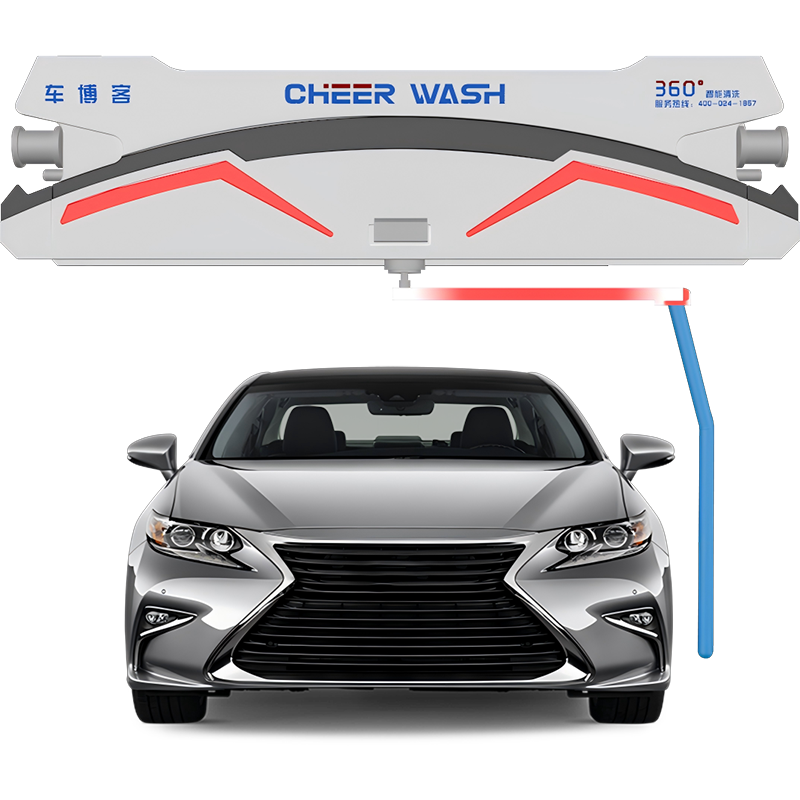
The vehicle cleaning industry faces a massive shift toward full automation. Facility owners constantly juggle demanding customer expectations against rising operational pressures. You need reliable systems balancing rapid throughput, precise chemical efficiency, and manageable maintenance schedules. Choosing the right hardware goes far beyond reading flashy marketing brochures. It requires matching technical application and projected returns directly to your exact business model. Making the wrong choice often leads to frustrating bottlenecks and inflated utility bills.
We will compare the CL500, CL600, and CL800 series objectively based on practical engineering rather than brand hype. You will learn how to evaluate these touchless car wash machine models using evidence-based criteria. This comprehensive guide helps you transition from casual interest to a confident selection. By the end, you will understand exactly how to align equipment specifications tailored for your specific site volume and unique vehicle demographics.
Key Takeaways
CL500 (Entry-Level/Low Volume): Ideal for smaller sites or businesses where space and budget constraints are primary drivers.
CL600 (Mid-Range/Versatile): The "sweet spot" for standard retail sites requiring balanced throughput and automated feature depth.
CL800 (High-Volume/Advanced): Engineered for high-throughput commercial hubs with intensive cleaning cycles and advanced sensor integration.
Selection Framework: Focus on the "Cost-per-Wash" vs. "Mean Time Between Failure" (MTBF) ratio rather than just upfront capital expenditure.
Decoding Your Requirements: Defining Success for Your Site
Every commercial facility operates under unique parameters. You must define success before looking at equipment specifications. Purchasing machinery blindly often disrupts daily workflows. A systematic evaluation prevents costly misalignments between hardware capabilities and customer demands.
Operational Volume Mapping
You must evaluate expected daily vehicle counts carefully. This reveals your peak-hour capacity constraint. Peak hours dictate your revenue ceiling. If your site processes 20 cars per hour on a Saturday afternoon, installing a slow machine creates traffic jams. Customers will drive away. Mapping volume involves studying local traffic data and existing competitor throughput.
Infrastructure Reality Check
Hardware upgrades demand strict infrastructure audits. You need to assess current bay dimensions. Measure length, width, and clearance heights accurately. Evaluate your existing power supply. Three-phase power is usually mandatory. Examine water reclamation requirements governed by local municipal codes. Failing to confirm utility capacities delays installation and inflates initial budgets.
Vehicle Demographics
Consider local market needs when choosing equipment. An area dominated by large SUVs requires different sprayer clearances than a neighborhood full of compact sedans. High-dirt regions facing harsh winters deal heavily with road salt. These environments demand extended pre-soak cycles and high-impact undercarriage blasters. Tailor your wash menu to the dirt your customers actually bring in.
Risk Mitigation
Downtime destroys daily revenue. You must understand how breakdowns impact your bottom line. Equipment reliability keeps cash flowing. Prioritize modular component access. When parts swap out quickly, technicians get your bay running faster. Evaluating mean time to repair (MTTR) protects your operational stability.
Common Mistake: Many operators estimate volume based on monthly averages. Always base equipment choices on your busiest two-hour window to avoid peak-time bottlenecking.
CL500: The Foundation for Small-Scale Operations
Smaller sites require reliable, straightforward technology. The CL500 serves the entry-level segment brilliantly. It delivers consistent cleaning without demanding complicated upkeep. This makes it an ideal fit for specific business models entering automated washing.
Core Specifications
The CL500 focuses on fundamental performance. You will find robust high-pressure pump outputs handling standard dirt loads perfectly. Basic sensor capabilities read vehicle presence and length. The spray arches utilize traditional fixed-angle geometry. While it lacks contour-following advanced robotics, it delivers forceful water impacts. This base touchless car wash machine ensures reliable daily washing.
Best-Fit Scenarios
This model shines as a replacement for labor-intensive manual bays. Labor shortages plague the manual wash industry. Upgrading to automation stabilizes revenue. It also serves low-traffic retail forecourts nicely. Gas stations processing 30 to 50 cars daily benefit immensely here. You get automated convenience without over-investing in unnecessary capacity.
Operational Trade-offs
Budget constraints require operational compromises. You must recognize the limits of cycle speeds. The CL500 takes slightly longer to complete a full pass. Automated chemical application precision remains basic. It uses standard dosing pumps rather than variable precision injectors. This limits your ability to create highly customized, multi-layer chemical treatments.
Long-Term Reliability
Mechanical simplicity breeds long-term reliability. A system operating at lower duty cycles faces less daily stress. Realistic maintenance expectations center around monthly grease checks and nozzle inspections. As long as you respect its designed volume limits, the machine runs smoothly for years. Pushing it beyond its rated daily capacity accelerates wear.
CL600: Scaling Performance for Mid-Market Efficiency
Mid-range retail sites demand faster cycles and better wash quality. The CL600 steps up to fill this gap. It introduces refined engineering designed to improve customer satisfaction and throughput simultaneously.
Feature Evolution
The CL600 improves significantly upon the entry-level baseline. It utilizes enhanced oscillating nozzles. These oscillating jets tear through road film more effectively by eliminating static spray blind spots. Improved frame coverage ensures consistent impingement across uneven vehicle surfaces. The arch design reaches lower rocker panels with greater accuracy.
Throughput Advantage
Every second counts during busy weekends. The transition from simple wash cycles to optimized wash-and-dry logic matters. The CL600 processes vehicles efficiently. It shaves valuable seconds off the total duration. The onboard drying systems overlap with the final rinse stage optimally. Faster cycles mean higher hourly revenue capabilities.
Chemical Economy
Chemical waste eats directly into profit margins. You must evaluate the return via more precise delivery systems. The CL600 uses improved manifold designs. These reduce chemical waste per vehicle. It delivers presoaks and waxes exactly where needed. Avoiding overspray lowers your monthly consumable bills dramatically.
Decision Logic
Knowing when to upgrade from a CL500 takes careful analysis. Look at your seasonal peak volumes. If customer lines regularly extend beyond three cars, upgrade. The business case for the higher initial investment validates itself quickly. You capture customers who would otherwise leave due to long wait times.
Best Practice: Calibrate your CL600 chemical dosing pumps quarterly. Seasonal temperature changes drastically alter chemical viscosity and draw rates.
CL800: High-Throughput Engineering for Industrial Demands
Commercial hubs demand unrelenting durability. The CL800 answers this call. Designers built it for intensive, non-stop cleaning cycles. This machine targets operations where failure is simply not an option.
Advanced Sensor Logic
Standard sensors miss complex vehicle shapes. The CL800 utilizes real-time contour mapping technology. It reads roof boxes, irregular spoilers, and extended mirrors seamlessly. The robotic arms adjust their distance actively. This ensures superior cleaning of complex profiles. It prevents collision damage while maintaining optimal water impact distances.
Throughput Optimization
This automatic touchless car wash equipment is built for sites demanding 24/7 reliability. It delivers the highest "cars-per-hour" metric in the lineup. High-speed drives and dual-axis movement systems accelerate every pass. When you service fleet accounts or high-volume commercial nodes, output speed dictates profitability.
Lifecycle Cost Comparison
Industrial components last longer under stress. Environments processing hundreds of cars daily destroy entry-level machines swiftly. The CL800 uses heavy-duty stainless steel frames and specialized sealed bearings. Lower-tier models require constant patching and repairs in busy settings. Investing in robust engineering initially reduces your long-term repair frequency. Heavy-duty drives prevent motor burnouts common in overworked standard units.
Compliance and Safety
High-frequency operations multiply safety risks. Advanced safety interlocks become essential. The CL800 features damage prevention technologies, including breakaway spray arms. If a driver accelerates unexpectedly, the arm yields rather than snapping. This protects the vehicle and the machine. Built-in compliance checks ensure chemical discharge remains within strict environmental standards.
Comparative Decision Matrix: Choosing the Right Equipment
You need data to finalize your decision. Comparing machines side-by-side reveals their true operational intent. We will break down the exact technical thresholds separating these units.
Technical Specifications Comparison Matrix
Feature Category
CL500 Series
CL600 Series
CL800 Series
Water Flow & Pressure
Standard pressure, fixed trajectory
Medium-high pressure, oscillating delivery
Variable high pressure, targeted profiling
Dwell Time Optimization
Basic standard programming
Dynamic timing controls
Precision wash-and-dry logic integration
Sensor Sensitivity
Standard infrared beams
Enhanced multi-point detection
Advanced 3D contour mapping
Target Volume
Low traffic (up to 50 cars/day)
Medium retail (50-120 cars/day)
High commercial (120+ cars/day)
Financial Impact Modeling
A good touchless car wash equipment comparison requires looking at payback periods. Estimate payback based on volume projections for each machine type. A CL500 pays for itself quickly in low-volume settings. Putting a CL800 in a low-traffic area stretches the payback period unnecessarily. Match capital expenditure closely to guaranteed daily revenue.
The "Avoidance" Audit
Look for key technical signs highlighting a mismatch. If your current machine burns through pump seals monthly, it is undersized. If you purchase equipment boasting complex contouring but only wash standard sedans, you oversized. Auditing your actual needs prevents tying up capital in unused features or bleeding cash on constant repairs.
Integration Feasibility
Consider the realities of deployment. Retrofitting older bays often presents spatial challenges for larger machines. New site construction allows custom bay sizing. Check high-pressure equipment footprints meticulously. The CL800 requires larger pump room allocations than the compact CL500. Ensure your mechanical room accommodates the necessary support skids.
Conclusion: Final Steps in Your Procurement Journey
The "best" touchless machine depends entirely on your specific site constraints. It is relative to your unique throughput ceiling and your staff's maintenance readiness. A low-volume forecourt thrives on mechanical simplicity, while a busy commercial hub demands industrial robotics.
You should request site-specific "Wash-Time-Analysis" reports from your suppliers. These customized reports model exact cycle times based on your chosen wash packages. They eliminate guesswork and provide accurate hourly capacity forecasts.
Finally, always prioritize modularity and local service-level agreements (SLAs). Pure hardware specifications matter little if you cannot source replacement parts locally. A robust machine paired with responsive maintenance support guarantees long-term operational success and consistent profitability.
FAQ
Q: How does machine maintenance differ between the CL500, CL600, and CL800?
A: The CL500 requires basic greasing and visual nozzle checks due to simple mechanics. The CL600 needs periodic calibration of its oscillating components and chemical manifolds. The CL800 involves stricter maintenance schedules, including sensor cleaning, software diagnostics, and inspection of its high-speed variable drives to maintain continuous heavy-duty operation.
Q: What infrastructure upgrades are typically required to support the CL800's higher power demands?
A: Transitioning to a CL800 usually necessitates upgrading to a robust three-phase electrical service. You may also need expanded mechanical room space to house larger high-pressure pump stations, heavier-duty water heaters, and enhanced water reclamation systems capable of matching its rapid cycle rates.
Q: Can the CL500 be upgraded to CL600 features later, or are they different architectures?
A: They largely feature different core architectures. While minor software tweaks or chemical pump adjustments remain possible, upgrading a CL500 to full CL600 specifications—like adding complex oscillating spray arches or advanced drying logic—is generally not feasible without replacing the primary gantry system.
Q: How do these machines account for local water hardness or chemical compliance regulations?
A: All models integrate standard water softening inputs. However, the CL600 and CL800 offer more precise chemical dilution manifolds, making it easier to calibrate pH levels locally. They integrate smoothly with closed-loop water reclaim systems to ensure compliance with strict municipal sewer discharge regulations.
Q: What is the expected average lifespan for these units in a high-volume commercial setting?
A: In a high-volume setting processing over 120 cars daily, an undersized CL500 faces premature failure within three years. Conversely, an industrial-grade CL800 routinely lasts 8 to 12 years under the same heavy load, provided you adhere strictly to routine preventative maintenance schedules.