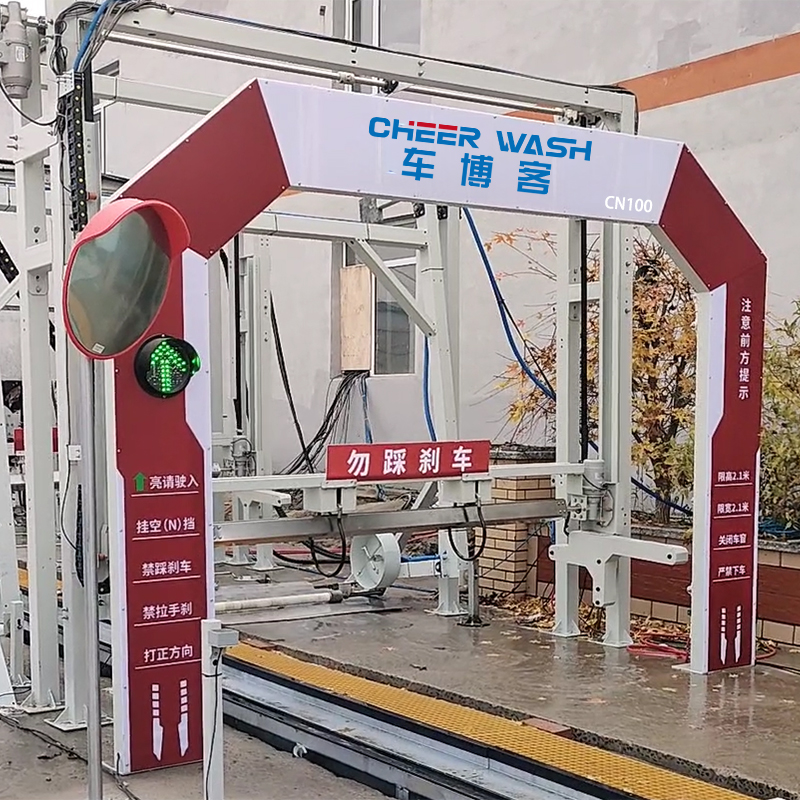
Modern vehicle geometries present unique challenges for wash operators. High beltlines, thick pillars, and massive hoods create physical barriers that standard friction systems simply cannot bypass. The rapid proliferation of Advanced Driver Assistance Systems (ADAS) and intervention systems redefines what constitutes a clean vehicle. Missed areas are now a critical failure point. Standard friction setups frequently fail to reach recessed areas and struggle to clean delicate exterior sensors safely. Side cameras, driving blind spot cameras, and radars require precision cleaning, yet traditional brushes often leave residue or cause alignment damage. Upgrading a Tunnel Car Wash Machine with strategically mapped, multiple high-pressure zones solves this problem directly. It provides a verifiable method to penetrate hard-to-reach areas, ensuring consistent wash quality while protecting sensitive vehicle technology from physical impact.
Geometry-Specific Targeting: Multiple high-pressure zones eliminate wash blind spots by utilizing precise angles to navigate the thick pillars and high hoods of modern SUVs and trucks, rather than relying solely on friction or high-volume flooding.
Sensor and ADAS Maintenance: Targeted pressure applications safely remove road film from blind-spot monitoring sensors, side cameras, and intervention systems without exceeding OEM impact tolerances.
Utility vs. Efficacy Trade-offs: Integrating these zones requires a rigorous evaluation of water reclaim capabilities, pump station capacity, and overall Gallons Per Minute (GPM) costs.
Hybrid Superiority: Combining friction with high-pressure touchless components yields the highest wash consistency across diverse vehicle profiles.
Defining "Vehicle Blind Spots" in an Automatic Tunnel Wash System
Physical Wash Blind Spots
Operators must identify the exact structural areas that standard friction brushes miss during a typical wash cycle. Deep front grilles, under rear spoilers, and rocker panels trap heavy dirt, magnesium chloride, and road salt. Recessed license plate cavities on step bumpers remain completely untouched by large-diameter friction materials. Modern trucks and SUVs feature massive vertical front blind zones. When a standard top brush encounters the vertical face of a heavy-duty truck hood, the brush climbs rapidly to avoid a collision. This climbing action creates a distinct shadow directly beneath the grille and behind the front bumper where the bristles never make contact. These geometric shadows require targeted water application at specific angles to break down accumulated road film. Without high-pressure intervention, these areas exit the tunnel just as dirty as they entered, leading to customer complaints and manual prep work that slows down the entire operation.
ADAS and Sensor Blind Spots
Modern vehicle sensors require precise cleaning to maintain driver safety systems. Side cameras embedded in thick pillars accumulate road grime quickly, blinding the lane-departure warning systems. Lower bumper radar arrays, used for adaptive cruise control and automatic emergency braking, sit in high-impact zones that take the brunt of insect impacts and road debris. Rear liftgate intervention sensors easily clog with winter salt and mud, rendering backup assists useless. An automatic tunnel wash system must clear these lenses without causing alignment issues or forcing water past weather seals. High-pressure zones must be calibrated to deliver enough force to remove baked-on bugs without exceeding the OEM impact tolerances of these delicate electronic components. A misaligned nozzle or excessive pressure can easily crack a sensor housing or force moisture into the wiring harness, resulting in expensive damage claims.
The Limitations of Single-Arch Systems
A monolithic approach to water pressure fails to adapt to the realities of a mixed-traffic wash tunnel. Single arches operate on a fixed trajectory and cannot adjust to varying vehicle sizes and high beltlines. When a compact car follows a lifted truck on the conveyor, a fixed arch optimized for the truck will be too far away from the car to clean effectively. High-pressure water loses impact force rapidly over distance due to atomization and air resistance. Fixed arches cannot compensate for the varying aerodynamic profiles. This limitation results in inconsistent cleaning performance across different vehicle classes. Furthermore, a single arch typically relies on a massive volume of water to compensate for its lack of precision, driving up utility costs and overwhelming the reclaim system. Targeted, multiple zones solve this by placing the water exactly where it is needed, at the exact distance required for maximum impact.
The Engineering Behind Multiple High Pressure Zones
Top-Down vs. Side-Profiling Pressure Arches
Overhead oscillating nozzles and fixed side-blasters serve distinct structural purposes within the wash bay. Top-down arches target hoods, roofs, and steep windshields. They cut through the upper aerodynamic profiles of modern vehicles, blasting away bird droppings and tree sap before the top brush makes contact. Side-profiling arches address high beltlines and thick pillars. Oscillating movements ensure water streams hit at multiple angles as the vehicle moves down the conveyor. This dynamic action dislodges stubborn debris from complex side moldings, door handles, and mirror housings. Relying on just one orientation leaves massive gaps in coverage. You need a combination of top-down and side-profiling manifolds to achieve full 360-degree coverage on complex vehicle geometries.
Integration with a Contour Following Car Wash Machine
Sonar or photo-eye profiling maps the vehicle in real-time as it enters the wash bay. This technology allows a contour following car wash machine to maintain an optimal distance from the surface throughout the entire cycle. High-pressure arches adapt instantly to sudden changes like steep windshields, roof racks, and high truck hoods. Water impact force degrades significantly over distance due to atmospheric resistance. A nozzle positioned 12 inches from the surface delivers exponentially more cleaning power than one positioned 36 inches away. Keeping nozzles close to the vehicle surface maximizes cleaning efficacy without requiring larger, energy-hungry pumps. This precise tracking ensures that the high-pressure streams maintain their kinetic energy right up to the point of impact, effectively shearing dirt away from the clear coat.
Touchless Car Wash Machine Components in a Hybrid Tunnel
Integrating touchless high-pressure modules complements friction zones perfectly. These modules blast away heavy abrasives like sand, grit, and ice buildup before any brush contact occurs. This pre-wash step protects the vehicle clear coat from scratch damage caused by grinding dirt into the paint. A hybrid approach leverages the heavy lifting of a touchless car wash machine alongside the polishing action of modern closed-cell foam brushes. It delivers superior results on heavily soiled vehicles while maintaining high conveyor speeds. By removing the bulk of the abrasive material with high pressure first, the friction materials stay cleaner longer, reducing the frequency of brush replacements and minimizing the risk of cross-contamination between vehicles.
Feature-to-Outcome: Mapping Pressure Zones to Specific Blind Spots
Bumper and Grille Blasters
Trucks and SUVs feature massive front-end cavities that act as scoops for insects and road debris. Bumper blasters penetrate these deep grilles for heavy bug and debris removal. They operate at specific angles to protect delicate radiator fins from bending under the force of the water. Front-facing intervention sensors receive a thorough cleaning without exceeding OEM impact tolerances. Proper alignment ensures water streams reach the back of the grille cavity, flushing out debris that would otherwise cause engine overheating issues. Operators must regularly check the pitch and yaw of these blasters to ensure they are hitting the target zone accurately as vehicles of varying heights pass through the beam.
Mirror and Window High-Pressure Manifolds
Side-mirror housings and thick pillar blind spots trap dirt easily, creating unsightly streaks as the vehicle exits the blowers. Targeted high-pressure manifolds focus specifically on these recessed areas. They keep side cameras clear for blind-spot monitoring and lane-departure systems. Precision nozzles prevent water from forcing past window weather seals, which can cause interior leaks and customer complaints. This targeted approach eliminates the dirty streaks often left behind by standard side brushes. The manifolds must be positioned to fire slightly backward, working with the forward motion of the conveyor to peel dirt away from the mirror glass without folding the mirror housing forward.
Rocker Panel and Undercarriage Applicators
The lower third of the vehicle suffers the most road abuse, accumulating a thick layer of grime, tar, and corrosive chemicals. Low-angle, upward-firing nozzles remove corrosive road salts and packed mud. They target areas below high beltlines where friction brushes struggle to reach effectively due to the curvature of the doors. Undercarriage applicators blast away debris from suspension components, exhaust systems, and fuel tank shields. This prevents long-term rust and maintains vehicle underbody integrity. High-volume, medium-pressure water is generally more effective here than low-volume, high-pressure water, as the goal is to flush heavy mud accumulations out of the wheel wells and off the chassis.
Rear-Facing High-Pressure Arrays
SUVs and trucks create an aerodynamic vacuum zone at the rear as they travel down the highway. This vacuum pulls dirt, exhaust soot, and road spray directly onto the back glass and liftgate. Angled rear-rinse systems overcome this common wash failure point. They fire water forward as the vehicle passes, matching the speed of the conveyor to maximize dwell time on the rear surface. This action keeps backup cameras and rear intervention sensors perfectly clear of grime. Without a dedicated rear-facing array, the back of an SUV will almost always require manual brushing before entering the tunnel, defeating the purpose of an automated system.
Evaluating High-Pressure Configurations for Your Tunnel Car Wash Machine
Success Criteria (Cleaning Efficacy vs. Vehicle Safety)
Establish a strict baseline for acceptable PSI and nozzle types to balance aggressive cleaning with vehicle safety. Zero-degree rotating nozzles provide high impact for wheels and rocker panels, cutting through baked-on brake dust. Fan spray nozzles offer safer, broader coverage for painted surfaces and delicate trim. Maximize cleaning power while strictly adhering to OEM safety standards. Delicate side cameras require calibrated pressure to avoid water intrusion and electrical failure. A standard rule of thumb is to keep surface impact pressure below 1200 PSI for painted surfaces and below 800 PSI for areas containing exposed sensors or cameras. Regular gauge checks in the pump room are mandatory to ensure these limits are not exceeded due to unloader valve failures.
Water Reclaim and Utility Scalability
High GPM requirements directly impact operational utility costs and municipal sewer surcharges. Analyze your current pump capacity before adding multiple high-pressure zones. Advanced water reclaim systems offset environmental and financial impacts. They filter and reuse water specifically for high-pressure undercarriage and rocker blasters, where potable water is not strictly necessary. This strategy keeps fresh water usage within acceptable municipal limits. When sizing a reclaim system for new high-pressure arches, calculate the total additional GPM and ensure your settling pits and cyclonic separators can handle the increased flow rate without allowing suspended solids to bypass the filtration media and destroy your high-pressure pump impellers.
Equipment Footprint and Tunnel Length
Assess existing tunnel infrastructure carefully before committing to new equipment. Determine if the conveyor length can accommodate additional arches and pump stations without crowding the existing friction zones. Adding high-pressure manifolds requires physical space on the floor and adequate distance between chemical applicators and the rinse arches.
Configuration Component
Space Requirement
Primary Target Area
Utility Impact (GPM)
Recommended Nozzle Type
Grille Blasters
2-3 feet
Front bumper, deep grilles
High
15-degree fan
Mirror Manifolds
1-2 feet
Side mirrors, thick pillars
Medium
25-degree fan
Contour Following Arch
4-5 feet
Hood, roof, rear glass
High
Zero-degree rotating
Rear-Facing Array
2-3 feet
Liftgate, backup cameras
Medium
15-degree fan
Ensure adequate chemical dwell time before high-pressure application. Rushing the wash process reduces the effectiveness of presoaks and detergents. If you install a high-pressure arch too close to the presoak applicators, you will blast the chemicals off the vehicle before they have time to break down the road film.
Implementation Risks and Mitigation Strategies
Sensor Calibration and Vehicle Profiling Failures
Contour-following systems can misread extreme vehicle dimensions if not properly maintained. Aftermarket roof racks, extended truck blind spot mirrors, or unusually high hoods pose collision risks. Implement software fail-safes to retract arches immediately when anomalies are detected. Regular sensor calibration prevents equipment collisions and expensive vehicle damage. Keep photo-eyes clean and aligned daily. A simple wipe-down of the sensor lenses at the start and end of each shift can prevent a catastrophic equipment failure. Additionally, ensure the tunnel controller software is updated to recognize the latest vehicle profiles, as the dimensions of modern electric vehicles and heavy-duty trucks continue to evolve.
Pump Station Maintenance and Nozzle Wear
High-pressure systems require rigorous maintenance routines to function correctly. Nozzles wear out over time, causing severe spray pattern degradation. Worn nozzles lead to significant pressure loss and poor cleaning performance. Schedule frequent nozzle replacements to maintain optimal impact force. Inspect pump stations for seal leaks, oil levels, and pressure drops weekly.
Check crankcase oil levels on all high-pressure pumps daily before startup.
Inspect unloader valves for proper bypass operation to prevent deadheading the pumps.
Replace spray nozzles every six months or when the spray pattern begins to feather and lose its sharp edge.
Monitor inlet water pressure to ensure pumps are not cavitating due to clogged supply filters.
Grease all motor bearings according to the manufacturer specified intervals.
Chemical and Pressure Imbalance
High-pressure zones risk washing away presoaks prematurely if placed incorrectly. This neutralizes the chemical breakdown of road film before it finishes reacting with the dirt. Optimize tunnel spacing to ensure proper chemical dwell time. Place high-pressure arches only after detergents have fully lifted the dirt from the clear coat. Adjust conveyor speeds to balance throughput with chemical efficacy. If the conveyor runs too fast, the high-pressure water will hit the vehicle before the presoak has had time to work, resulting in a poor wash. Conversely, if the conveyor runs too slow, the chemicals may dry on the paint before the high-pressure rinse can remove them. Finding the exact balance requires continuous titration checks and visual inspections of the vehicles exiting the blower zone.
Conclusion
Conduct a thorough site utility audit to determine available water volume and electrical panel capacity.
Measure the available tunnel length to ensure adequate chemical dwell time remains after installing new arches.
Request vendor proposals that specifically address high-pressure upgrades and water reclaim integration.
Inspect current pump stations and settling pits to determine if they can handle increased GPM loads and solid waste accumulation.
FAQ
Q: What is considered a vehicle blind spot in an automatic tunnel wash system?
A: A vehicle blind spot refers to structural areas that standard friction brushes miss. This includes deep front grilles, recessed license plate cavities, rocker panels, and the aerodynamic vacuum zones at the rear of SUVs. It also includes delicate ADAS sensors and side cameras.
Q: How do high-pressure zones adapt to the massive front blind zones and high hoods of modern SUVs and trucks?
A: High-pressure zones utilize strategically angled nozzles, such as bumper and grille blasters, to penetrate deep cavities. Instead of relying on top brushes that get blocked by high hoods, these targeted streams blast away debris from vertical front blind zones safely.
Q: How does a contour following car wash machine improve high-pressure cleaning?
A: It uses sonar or photo-eyes to map the vehicle exact profile. This allows the high-pressure arches to maintain an optimal, consistent distance from the surface. Keeping the nozzles close prevents water impact force degradation, maximizing cleaning efficacy.
Q: Is a touchless car wash machine safe for vehicle blind spot sensors, side cameras, and intervention systems?
A: Yes, when properly calibrated. Touchless systems use fan spray nozzles and regulated pressure to clean delicate sensors without exceeding OEM impact tolerances. This safely removes road film from side cameras and radar arrays without causing water intrusion.
Q: What is the optimal PSI for cleaning complex vehicle grilles and rear profiles?
A: The optimal pressure varies by nozzle type and distance. Generally, 800 to 1200 PSI at the impact point provides sufficient force to remove heavy bugs and debris from grilles and rear profiles without damaging radiator fins or vehicle paint.
Q: How do multiple high pressure zones affect a car wash water consumption?
A: Multiple high-pressure zones significantly increase Gallons Per Minute (GPM) requirements. Operators must evaluate their pump station capacity. Integrating an advanced water reclaim system is highly recommended to filter and reuse water, offsetting environmental and operational costs.
Q: Can high-pressure arches be retrofitted into an existing friction tunnel?
A: Yes, high-pressure arches can be retrofitted if the tunnel has adequate length and utility capacity. Operators must ensure there is enough physical space for the arches and sufficient distance to maintain proper chemical dwell time before the high-pressure rinse.