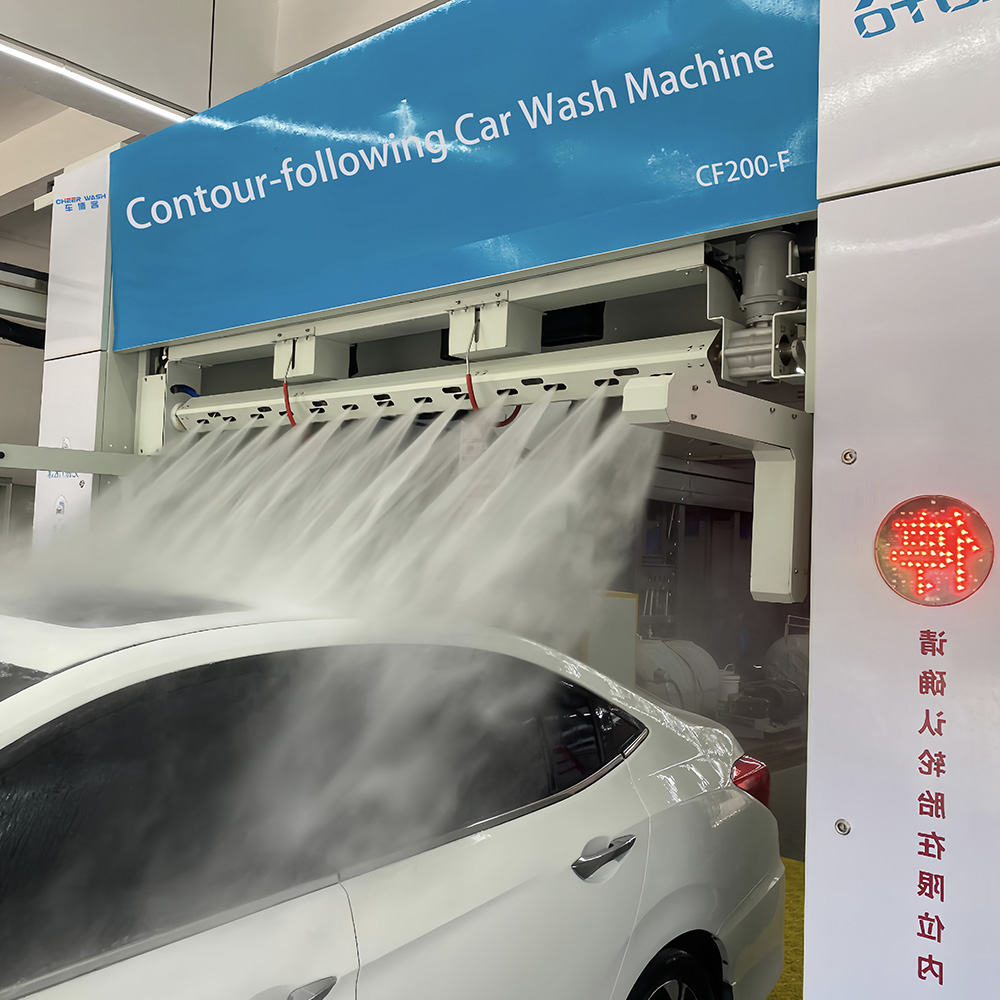
Fixed drying systems consistently fail to strip water from complex vehicle topography. This operational bottleneck leaves residual moisture on hoods, windshields, and rear glass, leading to hard mineral spotting and immediate customer complaints. When automated blowers leave cars wet, operators must rely on manual towel-drying labor at the tunnel exit. Manual drying drastically reduces tunnel throughput, increases daily overhead, and introduces severe liability for micro-scratches and clear coat erosion. You need a reliable method to manage water runoff without slowing down the line. The technical solution lies in dynamic proximity adjustment. A Contour-Following Car Wash Machine bridges the gap between high-speed throughput and premium drying quality. It utilizes advanced sensors to adapt to the natural curves of any vehicle, ensuring maximum aerodynamic efficiency and eliminating the need for manual intervention.
Proximity Equals Performance: Contour drying systems utilize dynamic actuation to keep blower nozzles at the optimal aerodynamic distance, maximizing water shear force.
Consistent Pressure Across Elevations: By tracking the vehicle's profile, these systems maintain consistent air pressure whether positioned over a low hood or a high roofline.
Sensor-Driven Precision: Modern systems rely on a combination of ultrasonic, photoelectric, or sonar sensors to map vehicle profiles in real-time without physical contact.
Risk vs. Reward: While a profiling car wash machine requires higher initial capital expenditure and specialized maintenance, the ROI is realized through reduced labor costs and higher premium wash conversions.
Safety Mechanisms are Critical: Evaluating these systems requires strict scrutiny of their collision-avoidance fallbacks and sensor reliability in high-moisture, chemical-heavy tunnel environments.
The Physics of Airflow: Why Distance Dictates Drying Efficacy
Automated drying systems must meet strict success criteria to be considered effective on the line. They must achieve complete water stripping across all vehicle surfaces, manage water runoff efficiently by pushing it down and away from the vehicle, and accomplish this without causing any physical damage. Achieving these criteria relies heavily on the principles of fluid dynamics and boundary layer physics. Water clings to a vehicle's clear coat due to surface tension. To break this tension, the air from the blower must penetrate the stagnant boundary layer of air resting directly on the vehicle surface. This requires massive, concentrated air velocity.
Air Velocity and the Inverse Square Law
Forced air behaves predictably when pushed through a restricted nozzle, but its effectiveness diminishes rapidly as it travels through open space. Air loses velocity exponentially as the distance from the nozzle to the vehicle surface increases. When you double the distance between the blower outlet and the car hood, you lose significantly more than half of the impact pressure. A 15-horsepower producer pushing air through a narrow nozzle opening generates massive shear force at a distance of two inches. If you move that same nozzle to 24 inches away, the force drops by over 70 percent. The high-velocity air simply diffuses into the surrounding tunnel atmosphere. The remaining airflow merely pushes the water around instead of shearing it off the clear coat. Maintaining a tight, consistent distance is mandatory for effective water removal.
The Straight-Line Flaw of Fixed Arches
Static dryers present a massive efficiency gap in modern wash operations. Operators must set fixed arches in straight, rigid lines and calibrate the height to clear the tallest potential vehicle entering the tunnel. If your wash accepts lifted pickup trucks or commercial transit vans, you must set your center blowers at 84 to 90 inches off the floor. This creates a severe operational flaw for the rest of your traffic.
When a low-profile sedan or a sports car measuring 55 inches tall enters the tunnel, the fixed nozzles remain suspended high above the vehicle. The distance between the nozzle and the hood easily exceeds 30 inches. At this distance, the aerodynamic shear force drops to near zero. Failing to follow the natural curves of the vehicle landscape guarantees poor drying results for lower vehicles. This forces staff to manually dry the cars, slowing down the entire operation. Common failure points for fixed dryers include:
Rear window shadowing where the air cannot reach the recessed glass.
Side mirror pooling that blows back across the doors when the vehicle accelerates.
License plate recesses that hold pockets of water.
Wiper cowl areas where water sits stagnant below the hood line.
To eliminate these wet spots, you must deploy a contour following car wash machine that physically lowers the nozzles to meet the vehicle surface, regardless of the vehicle's overall height.
Mechanics of a Sensor Guided Contour Wash System
To solve the distance problem, manufacturers developed dynamic systems that physically move the heavy drying hardware. These systems rely on a complex integration of sensors, software, and heavy-duty mechanical actuators. They work together in fractions of a second to adjust the equipment while the conveyor continues to pull the vehicle forward. A contour following wash system maintains a tight envelope around the vehicle, delivering maximum air pressure exactly where it is needed.
Real-Time Vehicle Mapping
The process begins the moment the vehicle approaches the drying zone. The system scans the vehicle upon entry to map its unique topography. The programmable logic controller (PLC) builds a digital silhouette of the car in its memory. Different manufacturers utilize different mapping technologies to build this profile.
Ultrasonic Sensors: These emit high-frequency sound waves that bounce off the vehicle surface. The system calculates distance based on the time it takes for the echo to return to the receiver.
Photoelectric Eyes: These create a dense grid of infrared light beams across the tunnel. As the vehicle breaks specific beams, the system builds a two-dimensional profile of the car's height and length.
3D Profiling: Advanced systems use LiDAR or stereoscopic cameras to generate a complete three-dimensional mesh of the vehicle, allowing for highly precise nozzle positioning.
Dynamic Actuation
Once the PLC maps the vehicle, it sends immediate commands to the mechanical components. The system utilizes variable frequency drives (VFDs) to control powerful 3-phase electric motors. These motors turn heavy-duty gearboxes connected to solid steel drive shafts. The shafts wind up Kevlar-reinforced polyurethane belts or heavy-duty lifting chains. The actuators rapidly raise, lower, and tilt the heavy aluminum drying nozzles.
They follow the mapped silhouette with extreme precision. The VFDs ensure smooth acceleration and deceleration of the blower assemblies. Instead of slamming the motors on and off, the VFD ramps the hertz up and down. This prevents jerky movements that could damage the equipment, snap the lifting belts, or cause the nozzles to swing erratically over the vehicle.
Airflow Vectoring and Runoff Management
Maintaining a consistent 2-to-4-inch distance allows the system to utilize concentrated, angled air blades. This close proximity unlocks the true power of the system. The equipment does not just blow air straight down onto the hood. It uses airflow vectoring to direct the blast at specific 15-to-25-degree angles. These angled blades act as a continuous, high-pressure barrier.
They manage water runoff by pushing moisture backward and down the slopes of the vehicle. The air curtain prevents water from pooling on flat surfaces like the hood, roof, and trunk lid. It forces the water past the vehicle's beltline, down the doors, and onto the floor grate. By keeping the nozzle close, the air maintains its structural integrity, acting like an invisible squeegee rather than a scattered breeze.
Evaluation Dimensions: Choosing a Profiling Car Wash Machine
Selecting the right equipment requires a deep understanding of your specific tunnel environment. Not all dynamic drying systems perform equally under heavy loads. You must evaluate the technical specifications that actually impact daily operations and moisture retention prevention. Choosing a reliable profiling car wash machine involves looking past the marketing claims and examining the core engineering.
Sensor Reliability in Harsh Environments
The wash tunnel is an incredibly hostile environment for sensitive electronics. Sensors must operate flawlessly amidst thick tunnel fog, chemical overspray, hydrofluoric acid from wheel cleaners, and near-100 percent humidity. You must evaluate how different sensor types handle these harsh conditions.
Sensor Technology
Strengths in Tunnel Environment
Vulnerabilities
Maintenance Requirements
Ultrasonic (Sonar)
Highly resistant to fog, steam, and airborne water droplets.
Can be confused by sharp, angled windshields that deflect sound waves away from the receiver.
Requires periodic wiping of the transducer face to remove chemical film.
Photoelectric (Infrared)
Extremely fast response time and highly accurate edge detection.
Lenses can become coated with wax or chemical film, causing false positive readings.
Requires daily manual cleaning of the transmitter and receiver lenses.
3D LiDAR / Optical
Provides the most detailed topographical map for complex vehicle shapes.
Highest initial cost and can struggle with heavy steam or highly reflective chrome surfaces.
Requires specialized software updates and careful lens calibration.
Actuator Speed and Response Time
Mechanical agility is a critical evaluation dimension. The system must react fast enough to handle your specific conveyor speeds. If you run a high-volume site processing 120 cars per hour, the conveyor moves the vehicle at roughly three feet per second. The drying nozzles must keep up with this pace. The actuators must drop from the high roof of a truck cab to the low flatbed in milliseconds.
If the actuator speed lags behind the conveyor speed, the nozzle will remain too high over the bed, leaving it completely wet. Worse, if the motor fails to wind the lifting belts quickly enough when a tall SUV approaches immediately after a low sedan, it risks a catastrophic collision. You must verify the maximum inches-per-second lifting speed of the hoist motors before purchasing.
Handling Complex Geometries
Modern vehicles feature highly complex geometries that challenge automated equipment. The system must accurately evaluate and navigate anomalies. Roof racks, police light bars, rear spoilers, ski boxes, and open pickup beds present unique obstacles. The software must include intelligent smoothing algorithms.
These algorithms tell the machine to ignore small gaps, like the space between a roof rack and the actual roof of the car. Instead of diving into the gap and risking a collision with the crossbars, the system glides smoothly over the highest point of the anomaly. The PLC uses a "look-ahead" function, storing the profile array in its memory and shifting it along with the conveyor pulse count. It sees the light bar coming, calculates the height, and instructs the VFD to ramp up the motor to lift the nozzle just in time.
Implementation Realities and Risk Mitigation
Upgrading to a dynamic drying system introduces new operational variables. You must address the practical challenges of installing and running a sensor guided contour wash. Proper risk mitigation ensures the equipment enhances your operation rather than complicating your daily maintenance routine.
Experience and Adoption Risks
Transitioning from fixed arches to moving equipment requires a shift in operational mindset. Staff must be trained to monitor the moving parts and understand the system's normal behavior to quickly identify anomalies. Installation requires heavy-duty aluminum or stainless steel arches. The dynamic load of a 300-pound blower assembly moving up and down creates massive torque and vibration on the frame. You cannot simply bolt these systems to flimsy existing supports; they require dedicated, floor-mounted structural framing.
You must also ensure your electrical panel can support the variable power draw. Dynamic arches require shielded VFD cables to prevent electromagnetic interference (EMI) from disrupting the low-voltage sensor signals. Running standard wire will result in erratic sensor readings and unpredictable machine behavior.
Collision Avoidance and Safety Fallbacks
Safety mechanisms are non-negotiable. You must implement mandatory fail-safes to protect customer vehicles. If a sensor fails or becomes blinded by chemical film, the system must default to a safe position.
Physical Limit Switches: These act as a hard stop. If the software fails and the motor keeps driving the nozzle down, the physical limit switch cuts power to the motor before the nozzle can crush a vehicle hood.
Breakaway Nozzle Designs: If a nozzle makes physical contact with a windshield, the joint utilizes shear pins or spring-loaded hinges. The nozzle snaps back freely, absorbing the impact and preventing glass breakage or paint damage.
Automatic Retraction Protocols: Upon detecting a fault code, a power loss, or a conveyor stop, the system must immediately retract all nozzles to the highest possible position and lock them in place using mechanical brakes.
Maintenance of Moving Parts
You must contrast the maintenance schedule of a contour dryer with the near-zero maintenance of fixed blowers. Fixed arches require little more than occasional nozzle tightening and greasing the motor bearings once a year. Dynamic systems require strict, scheduled maintenance. You must lubricate hoist chains and pillow block bearings regularly. You must inspect lift belts for fraying, stretching, or tension loss. Sensor faces require daily wiping with a microfiber cloth to remove wax buildup. Neglecting these tasks leads to sluggish actuator response, sensor blindness, and eventual system failure.
Tunnel Controller Integration
The profiling equipment must communicate seamlessly with your existing infrastructure. You must integrate the system with your point-of-sale (POS) and tunnel control software. This ensures synchronized timing. The POS sends a signal to the tunnel controller, which tracks the car using a pulse switch mounted on the conveyor head shaft. The controller tells the dryer exactly when the front bumper will arrive based on these conveyor pulses. If the timing is off by even a few pulses, the dryer might initiate its contouring sequence too early or too late. Proper integration guarantees the mapping data aligns perfectly with the physical position of the vehicle in the drying zone.
Conclusion
Measure your available tunnel exit space to confirm you have the minimum 10 to 15 feet of clearance required for dynamic actuator movement and safe vehicle spacing.
Audit your current electrical panel capacity to ensure it can support the variable power draw of new VFDs and 3-phase hoist motors without tripping breakers.
Request technical specification sheets from equipment manufacturers to compare sensor redundancy, lifting speeds, and breakaway nozzle designs.
Verify your existing tunnel controller software version to confirm compatibility with advanced profiling data integration and pulse-count tracking.
FAQ
Q: How close does a contour drying system get to the vehicle?
A: The industry standard range is 2 to 4 inches from the vehicle surface. This exact distance depends on the manufacturer's sensor calibration, the specific vehicle geometry, and the speed of your conveyor belt.
Q: How does a contour following wash system handle water pooling on flat vehicle surfaces?
A: By maintaining a close profile, the system creates a high-pressure air barrier. This angled air curtain forces water to flow down the vehicle's natural slopes, actively preventing moisture from pooling on flat areas like hoods and roofs.
Q: Can a contour following wash system damage a car?
A: Modern machines utilize strict safety mechanisms to prevent damage. Breakaway nozzles, physical limit switches, and redundant retract-sensors effectively mitigate physical impacts and stop the equipment before it can crush or scratch a vehicle.
Q: Do profiling car wash machines work on pickup trucks with open beds?
A: Yes. Advanced sonar and optical sensors detect the sudden drop-off of a truck bed. The system will either hold a safe high position or safely track the lower contour without blowing standing water back against the rear window.
Q: What is the maintenance difference between fixed and contour dryers?
A: Fixed arches require almost zero mechanical maintenance. Contour dryers require routine sensor cleaning, scheduled actuator lubrication, belt inspections, and periodic software updates to ensure the moving parts operate smoothly and safely.
Q: Can I retrofit a sensor guided contour wash dryer into an existing tunnel?
A: Yes, but it requires careful planning. You must evaluate your available tunnel space, ensure your electrical load capacities can handle the VFDs, and verify that your current tunnel controller is compatible with the new profiling software.