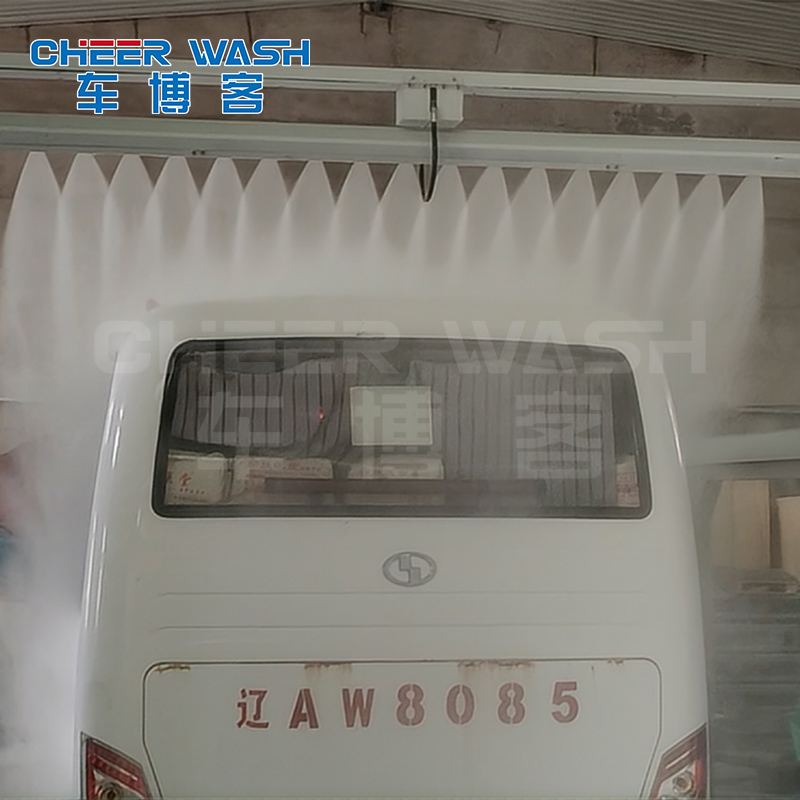
In touchless vehicle cleaning, mechanical friction is replaced entirely by applied fluid dynamics. The success of this process hinges on the precise synchronization of water pressure, chemical action, and application time. Operators frequently encounter inconsistent cleaning results—such as "striping," chemical residue, or untouched road film. Site managers often misdiagnose these issues as chemical failures, clogged nozzles, or pump malfunctions. They waste hours swapping out detergents or rebuilding valves when the actual culprit is improper rotating arm speed. Understanding the relationship between rotational speed, spray impingement, fluid motion patterns, and dwell time separates a profitable bay from a constant headache. Evaluating and configuring your equipment correctly guarantees wash uniformity and protects your operational returns. When operating a Touchless Car Wash Machine, mastering this mechanical balance is the only way to deliver a flawless finish without wasting water or chemistry.
Key Takeaways
Speed Dictates Impingement: Faster rotating arm speeds reduce the kinetic energy (impingement) of the water jet upon the vehicle surface, diminishing the system's ability to break the static bond of road dirt.
Dwell Time is Non-Negotiable: Optimal chemical performance requires specific dwell times; arm rotation must be slow enough to allow presoaks to react, but fast enough to prevent drying.
Overlap Prevents Striping: Wash uniformity relies on the mathematical overlap of spray patterns. Exceeding the optimal RPM breaks this overlap, resulting in the "zebra effect" (missed vertical stripes).
Rinse Speed Impacts Drying Efficiency: The rotational speed of the final rinse directly affects water sheeting, which in turn dictates the efficiency and required time for forced-air blowers to dry the vehicle.
Variable Control is a Procurement Standard: Modern commercial contactless car wash systems must feature Variable Frequency Drives (VFDs) to allow operators to customize arm speeds for different wash cycles (e.g., slow for high-pH presoak, fast for clear coat protectant).
The Physics of Wash Uniformity in a Touchless Car Wash Machine
Problem Framing (Success Criteria)
Wash uniformity means delivering consistent water pressure and chemical concentration across 100% of the vehicle's exposed surface area. You cannot have shadowing behind mirrors, banding along door panels, or dry spots on the rear bumper. Achieving this requires precise mechanical calibration at the boom. If the spray pattern breaks or the impact force drops before hitting the clear coat, the wash fails. Uniformity serves as the baseline metric for site success. Without it, you waste heated water, over-apply expensive chemicals, and lose your customer base due to visibly poor wash quality.
Centrifugal Force vs. Spray Impact
The rotational velocity of the arm directly alters the trajectory and impact force of the water droplets. Water exits the stainless steel nozzle at a specific velocity driven by the high-pressure pump room. As the overhead arm rotates, it introduces lateral centrifugal force to that water stream. If you spin the arm too fast, this lateral force overcomes the forward momentum of the water. The result is premature droplet atomization. The solid water stream tears apart into a fine mist before it ever reaches the vehicle surface. Mist lacks the kinetic energy, or impingement, required to blast away heavy soils, magnesium chloride, or baked-on bugs. To maintain actual cleaning power, the rotational speed must allow the water jet to remain a cohesive, heavy liquid blade upon impact.
Fluid Motion Patterns and Shear Force
Touchless cleaning relies entirely on complex sliding and shearing actions. Water must strike the vehicle at a specific angle and velocity to create shear force. This shear force physically lifts dirt particles from the surface, mimicking the abrasive action of friction brushes without making physical contact. Rotational speed dictates how this shear force travels across the vehicle panels. A properly timed rotation ensures the water blade pushes dirt downward and away from the clean zones. If the rotation is too rapid, the shear force skips over the surface contours. The water simply bounces off the clear coat rather than sliding under the road film to lift it away.
Dwell Time and Chemical Efficacy
Chemicals do not clean instantly upon contact. They require specific dwell times to break the static bonds holding dirt to the paint. Arm speed determines chemical saturation and how long that chemical sits active on the surface. A low-pH presoak cycle needs a moderate application speed to ensure even coverage without running off into the pit too quickly. Conversely, a foam wax touchless wash machine application requires a much slower rotation. The wax must lay down in a thick, even blanket to bond properly with the clear coat. Moving too fast during chemical application results in thin, patchy coverage and inadequate reaction time, leaving a dirty film behind.
To verify your spray impact and fluid motion are functioning correctly, follow these field checks:
Measure the static pressure at the pump manifold and compare it to the dynamic pressure at the boom rotary union to identify pressure drops.
Inspect the nozzle tips for wear; a worn orifice changes the spray angle and reduces impingement regardless of arm speed.
Run a test cycle on a dry vehicle and measure the exact time it takes for the presoak to begin breaking the dirt bond.
Adjust the VFD frequency down by 2Hz increments until the water stream remains solid upon impact with the vehicle's side panels.
Fast vs. Slow Rotation: Trade-offs in an Integrated Touchless Wash System
Configuring an integrated touchless wash system requires balancing your throughput expectations against the hard physics of cleaning. You must choose baseline speed configurations that align with your site's specific demands, local climate, and seasonal soil conditions.
High-Speed Rotation Dynamics
High-speed rotation maximizes throughput. It increases the total cars-per-hour processed through the bay, which is highly desirable on busy weekends. Fast rotation proves highly effective for rapid rinsing passes, particularly clear coat protectants and spot-free reverse osmosis water applications. A highly optimized, fast spot-free rinse pass improves water sheeting. It extracts maximum residual chemicals quickly, reducing the burden on your forced-air blowers and preventing water spots.
However, the drawbacks of running high speeds constantly are severe. High speed causes a massive reduction in surface impingement. The water simply lacks the punch to clean heavily soiled vehicles. It also creates a high risk of "shadowing." Fast-moving arms sweep past complex vehicle geometries—like side mirrors, rear spoilers, and recessed license plates—too quickly for the water to penetrate the hidden areas. Furthermore, high-speed chemical application provides inadequate reaction time, rendering expensive presoaks largely ineffective.
Low-Speed Rotation Dynamics
Low-speed rotation prioritizes wash quality over raw volume. It delivers maximum impact pressure. The water jet remains cohesive, striking the vehicle with full kinetic energy. This speed ensures thorough chemical coverage and provides superior cleaning of heavy, baked-on soils like winter road salt or summer tree sap. The slower movement allows the spray to penetrate deep into wheel wells and behind vehicle contours.
The primary disadvantage is reduced throughput. Slower cycles mean fewer cars processed per hour, which creates bottlenecks during peak operating times. Additionally, in high-temperature environments, applying chemicals too slowly carries the risk of the product drying on the vehicle surface before the high-pressure rinse cycle can remove it. This causes chemical staining on the clear coat and glass, leading to customer complaints and damage claims.
Calculating the "Goldilocks" Zone (Car Wash Mathematics)
Finding the optimal RPM requires mathematical calibration at the controller. You must evaluate the correct speed based on pump output (measured in GPM and PSI), the nozzle spray angle (typically 15° or 25°), and the physical stand-off distance from the nozzle to the vehicle surface. A 15° nozzle delivers higher impact but requires a tighter overlap, necessitating a specific RPM to prevent striping. A 25° nozzle covers more area but strikes with less force.
You must align programmed cycle times with actual rotational speeds. This accurately projects true Cars-Per-Hour (CPH) without throughput discrepancies. If the math dictates a 14 RPM speed for optimal cleaning, the total cycle time must be built around that constant. Forcing a faster RPM simply to reduce cycle time mathematically guarantees a drop in wash quality.
Operational Metric
High-Speed Rotation (20+ RPM)
Low-Speed Rotation (10-15 RPM)
Surface Impingement
Low (High risk of droplet atomization)
High (Maximum kinetic energy retention)
Chemical Dwell Time
Inadequate (Risk of poor soil breakdown)
Optimal (Allows full chemical reaction)
Throughput (CPH)
High (Faster bay turnover)
Lower (Longer cycle times)
Shadowing Risk
High (Misses areas behind mirrors/spoilers)
Low (Thorough penetration of contours)
Drying Efficiency
Excellent (Promotes rapid water sheeting)
Moderate (May leave heavy water beads)
Evaluating Automatic Touchless Wash Equipment by Arm Design
Hardware design dictates speed capabilities, wash quality, and machine longevity. When sourcing automatic touchless wash equipment, you must scrutinize the mechanical architecture of the rotating arm assembly before looking at any other feature.
Single-Arm vs. Dual-Arm Configurations
The number of rotating arms fundamentally alters speed requirements. Dual-arm systems can operate at lower individual RPMs while maintaining high overall throughput. Because two arms apply water or chemicals simultaneously, each arm only needs to cover half the distance in the same timeframe. This allows for high impingement and excellent dwell time without sacrificing cars-per-hour. Single-arm systems, by contrast, must rotate much faster to achieve the same cycle time. This forces you to walk a tightrope between maintaining throughput and losing impingement due to excessive speed.
Vibration Dampening and Structural Stability
Rapid RPM shifts generate massive g-forces. A rotating arm filled with pressurized water acts as a heavy pendulum. When it starts, stops, or changes direction, it transfers extreme kinetic energy into the machine's frame. Gantry and boom designs must feature robust vibration dampening to prevent the system from shaking itself apart. Structural stability ensures that the nozzles maintain their precise distance and angle relative to the vehicle. If the boom wobbles due to poor stability at high speeds, the spray pattern distorts, instantly destroying wash uniformity.
The Necessity of Variable Frequency Drives (VFDs)
Fixed-speed rotating arms are completely obsolete for high-volume operations. Modern systems must utilize Variable Frequency Drives (VFDs). A VFD controls the frequency of the electrical power supplied to the arm's drive motor, allowing for infinite speed adjustments. VFDs allow for cycle-specific speed profiling. You can program the machine to run at 12 RPM for a heavy high-pH presoak, slow down to 10 RPM for a thick foam wax application, and then accelerate to 22 RPM for a rapid spot-free rinse. This dynamic control is non-negotiable for maximizing both wash quality and throughput.
Sensor-Driven Speed Profiling
Advanced equipment utilizes ultrasonic or infrared sensors to map the vehicle's profile in real-time. Sensor-driven systems dynamically adjust arm speed based on vehicle sizing. The machine automatically slows down when washing larger surface areas, such as the broad side panels of a heavy-duty truck, ensuring adequate chemical coverage and impingement. Conversely, it speeds up when washing a compact car, saving time and water. This intelligent speed profiling eliminates the need for a "one-size-fits-all" cycle, optimizing the wash for every specific vehicle that enters the bay.
When inspecting the hardware of a rotating arm assembly, check these specific points:
Inspect the rotary union seals for weeping water, which indicates bearing wear from excessive RPM.
Check the gearbox for oil leaks caused by high torque loads during rapid direction changes.
Verify the VFD parameters match the motor nameplate data to prevent overheating the drive.
Measure the actual RPM with a tachometer to confirm the controller output matches the physical rotation.
Examine the boom carriage rollers for flat spots caused by aggressive acceleration profiles.
Implementation Risks: When Arm Speed Calibration Fails
Poorly calibrated equipment carries severe physical and mechanical consequences. Failing to match arm speed with pump output and nozzle geometry leads directly to wash failures and expensive equipment breakdowns.
The "Zebra Effect" (Striping)
The most common visual indicator of speed calibration failure is the "zebra effect." This occurs when the arm RPM exceeds the nozzle spray pattern overlap, creating unwashed diagonal or vertical stripes across the vehicle. Water jets are designed to overlap slightly, ensuring 100% coverage. If the arm moves too fast, the vehicle moves forward before the next rotation can cover the adjacent section. The overlap breaks. Mitigating this requires recalculating the RPM against the nozzle degree and the boom distance. You must slow the arm down via the VFD until the spray patterns seamlessly merge on the vehicle surface.
Mechanical Wear, Tear, and Structural Stress
Excessive rotational speed accelerates component failure. High g-forces, rotational torque, and severe vibration place immense stress on swivels, bearings, and rotary unions. A rotary union transferring water at 1200 PSI while spinning at excessive speeds experiences rapid seal degradation. The lateral forces cause the bearings to wear unevenly, leading to boom wobble. Boom wobble further distorts the spray pattern and increases maintenance downtime. Operating beyond the engineered speed limits turns a reliable machine into a constant maintenance liability.
Mitigation Strategies for Operators
You must establish a routine calibration schedule. Do not assume factory settings remain accurate after months of operation. Conduct visual overlap tests weekly. Run a test wash on a dry, dusty vehicle and inspect the spray pattern for any breaks or striping. Perform regular nozzle maintenance. A partially clogged nozzle alters the spray angle, which in turn requires a different RPM to maintain overlap. Ensure the speed matches the actual, real-world spray integrity of the nozzles currently installed on the boom.
Visual Symptom
Mechanical Cause
Corrective Action
Vertical dirt stripes (Zebra effect)
Arm RPM too high for nozzle angle
Decrease VFD frequency by 5Hz and retest overlap.
Chemical drying on panels
Arm RPM too low during presoak
Increase RPM or increase chemical volume output.
Boom wobble during rotation
Worn rotary union bearings due to high g-force
Rebuild rotary union and verify speed limits in controller.
Poor bug removal on front grill
Insufficient dwell time or low impingement
Slow down the front-pass speed profile to increase impact.
Conclusion
Wash uniformity is mathematically tied to rotating arm speed. Systems lacking the ability to precisely control and vary this speed inherently compromise wash quality, machine lifespan, or throughput. Relying on fixed-speed systems forces you to accept mediocre cleaning results or excessive maintenance costs. Precision control is the only path to consistent operational success.
When upgrading to a commercial contactless car wash, prioritize manufacturers that build around variable control. Look for VFD-controlled rotating arms, dual-arm configurations for high-volume sites, robust vibration dampening, and ultrasonic vehicle profiling. These features are mechanical requirements for processing diverse vehicle types effectively.
Take the following steps to optimize your current operation:
Audit your current wash cycle times and measure the exact RPM of your equipment during both chemical and high-pressure passes.
Inspect vehicles exiting the bay under bright lighting to identify any striping or chemical shadowing.
Consult with your equipment vendor to retrofit VFDs if your current system relies on fixed-speed contactors.
Establish a monthly maintenance schedule to clean nozzles and verify that the spray overlap remains mathematically correct.
FAQ
Q: How fast should the rotating arm spin on a touchless car wash machine?
A: Optimal speed varies by cycle. A touchless car wash machine typically ranges from 10 to 20 RPM. Slower speeds (10-14 RPM) are required for applying presoaks to allow chemical dwell time. Faster speeds (18-22 RPM) are used for high-pressure rinses and spot-free applications to promote rapid water sheeting.
Q: Why does my integrated touchless wash system leave dirty stripes on cars?
A: This is the "zebra effect." It occurs when the arm rotates too fast for the nozzle spray angle. The excessive speed breaks the necessary mathematical overlap of the water jets, leaving unwashed diagonal or vertical stripes on the vehicle surface.
Q: Does a faster wash cycle reduce cleaning quality in automatic touchless wash equipment?
A: Yes. Excessive speed reduces water impingement, meaning the impact force drops as droplets atomize before hitting the surface. It also severely limits the chemical dwell time required to break down heavy road film and soils.
Q: Does the rotational speed of the final rinse affect vehicle drying time?
A: Yes. An optimized, faster final rinse speed ensures proper water sheeting. This action extracts residual moisture from the clear coat, significantly reducing the time and energy required by the forced-air blowers to dry the vehicle.
Q: Can I adjust the arm speed on an older commercial contactless car wash?
A: It depends on the drive mechanism. Many older systems can be retrofitted with Variable Frequency Drives (VFDs) if they use AC motors. Hydraulically driven systems may require adjusting hydraulic flow control valves to alter the rotational speed.
Q: What is the best arm speed for a foam wax touchless wash machine application?
A: Foam wax requires a slower, highly controlled rotation. This ensures even, thick coverage of the wax or protectant across the entire vehicle without atomizing the product into a fine mist before it can bond with the clear coat.