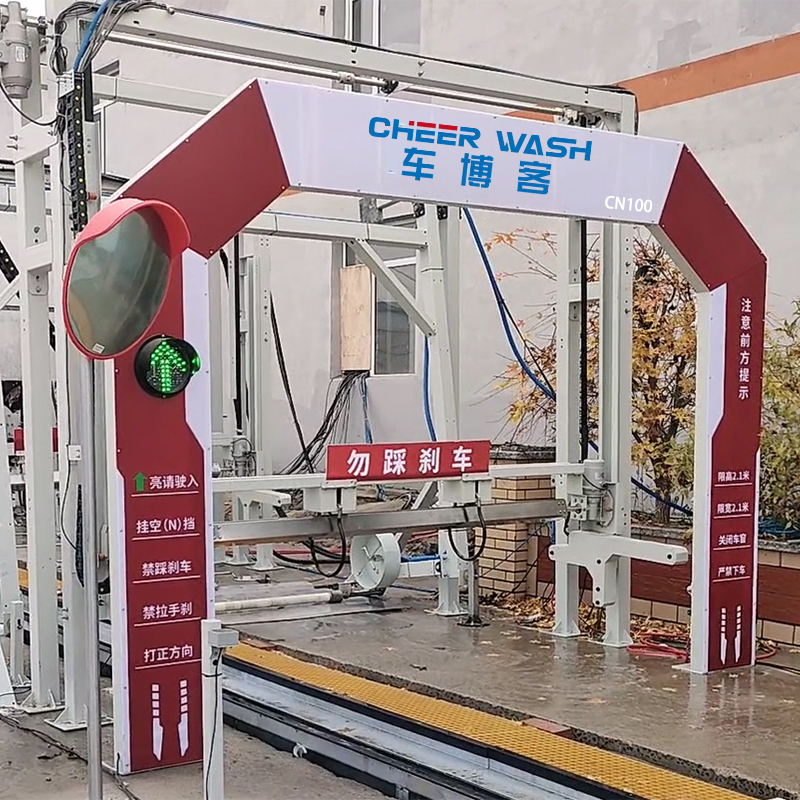
The fundamental revenue ceiling in the car wash industry comes down to a simple metric: profitability is strictly bound by your maximum cars-per-hour (CPH) during peak operating windows. When the sun comes out after a long week of rain or a heavy winter storm, your site will experience a massive surge in demand. If your equipment cannot process that surge quickly, you face an immediate operational bottleneck. Customers see long queues backing up into the street, abandon the line, and drive away. That lost traffic translates directly to capped daily revenue that you can never recover.
Operators facing this bottleneck must make a critical technical evaluation. You have to decide whether to upgrade to a continuous-flow system or maintain a stationary in-bay setup. The right choice depends entirely on a strict analysis of your available site footprint, capital expenditure limits, and projected daily volume. Making the wrong choice either strangles your throughput or leaves you drowning in overhead costs you cannot justify.
- Throughput Disparity: Tunnels process vehicles continuously (often 50–150+ CPH), whereas rollovers are limited by sequential batch processing (typically 8–15 CPH).
- Footprint Realities: Rollovers require minimal space (standard in-bay dimensions), while traditional tunnels demand significant linear footage, though modern "mini-tunnels" (approx. 18 meters/60 feet) are bridging this gap by enabling up to 60 CPH on rollover-sized plots.
- Financial Trade-offs: The high initial CapEx of automatic tunnel wash equipment requires a verified high-volume site to achieve ROI, whereas rollovers offer lower entry costs but cap long-term revenue potential.
- Operational Complexity: Tunnels require more intensive preventative maintenance, utility management, and often dedicated on-site labor compared to unattended rollover systems.
Defining Success for a High Volume Car Wash
Establishing what actually constitutes a high volume car wash requires looking at industry baselines and physical site capabilities. Processing 300 or more cars per day generally pushes a site into the high-volume category. However, daily averages can be deceptive. Peak-hour demand truly dictates your equipment requirements. If a massive percentage of your daily volume arrives between 10:00 AM and 2:00 PM on a Saturday, your system must handle that concentrated burst without faltering. Equipment that runs fine at 10 CPH on a Tuesday morning will completely fail your business model during a weekend rush.
The financial impact of queue abandonment is severe and immediate. When a line stretches past your property line, potential customers simply keep driving. The limits of the stop-and-go wash model become painfully obvious during peak weekend rushes or post-weather event surges. Every minute a car sits stationary in a bay while brushes roll over it is a minute the next customer spends waiting. If your wash cycle takes four minutes, your absolute maximum capacity is 15 cars per hour. You cannot cheat this mathematical limit, no matter how efficient your payment kiosks are.
To solve this, operators need a concrete decision framework. You must evaluate core criteria systematically to ensure your site can physically and financially support an upgrade. Follow these steps when evaluating your property:
- Measure total available linear footage to determine if a conveyor trench is physically possible without violating municipal setbacks.
- Calculate your peak CPH requirements based on historical traffic data during your busiest operating hours.
- Audit your existing utility infrastructure, specifically checking for three-phase electrical service and adequate water tap sizes.
- Assess available stacking space to ensure high-volume processing will not cause dangerous street backups.
Core Architectural Differences & Machine-Vehicle Interaction
The Tunnel Car Wash Machine (Continuous Movement)
The defining characteristic of a Tunnel Car Wash Machine is continuous movement. A heavy-duty conveyor chain and roller system, or a modern dual-belt conveyor, pulls vehicles through a series of staged wash zones. The arches, chemical applicators, friction brushes, and blowers remain completely stationary bolted to the concrete floor. The vehicle moves through the prep, wash, rinse, wax, and dry stages at a controlled, steady speed.
This continuous movement fundamentally changes throughput mechanics. Because the equipment is spread out linearly down a long corridor, multiple vehicles occupy the wash simultaneously. As one car enters the high-velocity drying zone, another is receiving clear coat protectant, and a third is just hitting the initial friction wraps. This overlapping process exponentially increases your CPH. High-volume sites can process a new vehicle every 30 to 45 seconds, keeping the queue moving constantly and preventing customer drive-offs.
The mechanical room supporting this continuous movement is extensive. You will find large hydraulic power packs driving the brushes, massive air compressors for pneumatic retracts, and complex chemical dispensing systems that mix and pump detergents to dozens of different arches simultaneously. The infrastructure required to support this continuous flow is heavy industrial grade.
The Rollover System (In-Bay Automatic)
The rollover system operates on an entirely different mechanical principle. The vehicle drives into a bay, parks over a floor switch or ultrasonic sensor, and remains completely stationary. A large steel or aluminum gantry then rolls back and forth over the car on floor-mounted rails. This single gantry houses all the necessary equipment—high-pressure nozzles, closed-cell foam brushes, and chemical manifolds—and executes different wash stages sequentially.
Throughput limitations are hardwired into this design. Sequential processing means a single car must complete every single phase of the wash before the bay doors open for the next customer. If you offer a premium wash package with undercarriage spray, double soap passes, tri-color foam, clear coat protectant, and an extended dry cycle, the gantry must make multiple passes. This process takes time. That strictly limits your output. No matter how much demand sits in your driveway, the machine cannot move faster than its programmed sequential cycle.
The advantage here is simplicity. The mechanical room for a rollover is often just a small closet housing a single pump stand and a few chemical pails. The footprint is small, and the installation is straightforward, but the ceiling on your volume is permanently fixed by the speed of the gantry.
![Tunnel vs Rollover Car Wash Comparison]()
Tunnel vs. Rollover Car Wash Comparison: Evaluation Dimensions
Throughput and Revenue Ceilings
When conducting a rollover car wash comparison against continuous systems, peak capacity is the most glaring difference. Standard rollovers max out between 8 and 15 CPH. Modern mini-tunnels push that number to 35–60 CPH. Full-length express tunnels can easily exceed 100 CPH. This creates a massive gap in volume potential during your busiest hours.
There is an interesting technical nuance here known as the track speed paradox. A rollover gantry actually moves at very high track speeds to wash a single vehicle quickly. It zips back and forth over the stationary car, spraying and scrubbing rapidly. Conversely, a tunnel conveyor moves quite slowly—often just a few inches per second. Yet, the slow, steady-moving conveyor yields vastly superior hourly throughput because it processes multiple vehicles simultaneously. Speed of the equipment does not equal speed of processing.
Calculating maximum daily volume requires multiplying your average wash package selection by your peak CPH, then factoring in your busy hours. A rollover maxing out at 15 CPH generates a fraction of the volume of a continuous line processing 80 CPH. Over an eight-hour Saturday shift, that volume difference dictates whether your site dominates the local market or struggles to capture peak demand.
| System Type | Typical CPH | Processing Method | Volume Multiplier vs Standard |
| Standard Rollover | 8 - 15 | Sequential / Batch | 1x Base Volume |
| Mini-Tunnel (18m) | 35 - 60 | Continuous / Overlapping | 3x - 4x Base Volume |
| Full Express Tunnel | 100+ | Continuous / Overlapping | 8x+ Base Volume |
Real Estate and Site Footprint Constraints
Linear footage requirements dictate what you can actually build on your dirt. A typical rollover requires a 30 to 40-foot bay. Traditional continuous lines demand 50 to 150+ feet of linear space just for the building, not including the necessary turn radius for vehicles entering and exiting the conveyor. You need wide, sweeping turns to allow large trucks and SUVs to align their tires with the conveyor guide rails safely.
However, the 18-meter plot benchmark has changed the industry. Manufacturers now engineer compact systems that pack 60 CPH capacity into an 18-meter (roughly 60-foot) footprint. These mini-tunnels directly compete for the same plot size as a traditional rollover, allowing operators with constrained real estate to drastically increase their throughput without buying adjacent land.
You must also account for stacking and queue space. Processing 80 cars an hour means cars arrive rapidly. If you do not have adequate stacking lanes on your property, the queue will back up into the public street. Municipalities will fine you, and traffic cops will force you to shut down temporarily. Stacking space is often overlooked in site planning, but it is just as critical as the building footprint. You need enough driveway space to hold at least 10 to 15 cars before they reach the payment terminals.
Utility Consumption and Cost Per Car
Evaluating per-car utility costs reveals surprising efficiencies. While a massive continuous facility uses more total water and electricity per day, the utility draw per vehicle is often lower. Continuous lines frequently utilize advanced underground water reclamation systems. They capture, filter, and reuse water for the initial prep and friction stages, only using fresh reverse osmosis (RO) water for the final rinse. This drives the per-car water usage down significantly.
Power draw is a different story. The electrical infrastructure required to run simultaneous arches, massive hydraulic power packs, and multiple 15-horsepower drying blowers is immense. A single rollover gantry runs on a fraction of that power. You must verify that your local utility grid can supply the necessary three-phase power before committing to a conveyor upgrade. Upgrading a site from single-phase to three-phase power involves pulling new lines from the street, installing new transformers, and completely rebuilding your motor control center (MCC).
Financial Viability: CapEx vs. Long-Term ROI
Initial Investment for Automatic Tunnel Wash Equipment
The upfront capital required for automatic tunnel wash equipment is starkly different from purchasing a self-contained rollover unit. You are buying heavy-duty steel conveyors, dozens of specialized stainless steel arches, high-horsepower blowers, complex motor control centers, and advanced point-of-sale systems. The equipment alone requires a massive capital injection.
Beyond the machinery, site prep and construction carry heavy hidden costs. Installing a conveyor requires cutting existing concrete, digging deep trenches, and pouring new pits for the drive chain and take-up rollers. You will likely need upgraded utility drops, larger water tap sizes from the city, and extensive plumbing work to handle the increased flow rates. These structural modifications often equal or exceed the cost of the equipment itself. You are essentially building a small industrial manufacturing plant designed to process vehicles.
Maintenance, Labor, and Operational Overhead
Preventative maintenance scales with complexity. A continuous facility contains dozens of moving parts, gearboxes, hydraulic motors, and photo-eye sensors. If a single bearing seizes on the conveyor, the entire line stops. Maintenance must be proactive, requiring daily inspections, greasing of universal joints, and calibration of chemical draw rates. Rollovers consolidate maintenance into a single moving gantry, making it much easier for a single operator to manage with basic hand tools.
Labor requirements also shift dramatically. Rollovers are designed to be fully unattended. A customer pays at the kiosk, drives in, and leaves. Conveyor systems generally require at least one attendant to guide vehicles onto the track, ensure vehicles are in neutral, and handle prep work. High-volume sites often need two or three employees on shift to manage traffic flow, empty trash cans in the vacuum area, and handle customer service issues. You are moving from a passive income model to an active retail management model.
Break-Even Analysis Framework
Operators must determine the exact daily car count required to justify transitioning from a stationary bay to a continuous line. You need a realistic volume threshold. Calculate your total monthly debt service for the new equipment and construction, add your increased utility and labor overhead, and divide that by your net margin per car. If the math requires you to wash 150 cars a day just to break even, but your local traffic counts only support 100 cars a day, the upgrade will fail. Ensure your site has the verified demand to support the heavy infrastructure.
Implementation Risks & Mitigation Strategies
Converting an In-Bay to a Tunnel Wash System
Many operators look at their existing 40-to-60-foot rollover bay and wonder if they can execute a mini-tunnel retrofit. Converting an existing building into a tunnel wash system is feasible, but it requires compromises. When you condense equipment into a tight space, you sacrifice drip space. The distance between the final rinse and the blowers is shortened, which can negatively impact drying efficacy. You may need to invest in more powerful blowers, heated air systems, or specialized drying agents to compensate for the lack of physical space.
Structural modifications carry significant risk. Retrofitting existing concrete to accommodate a conveyor trench often uncovers old plumbing issues or structural weaknesses in the foundation. Drainage systems designed for 15 CPH will quickly overflow when hit with the water volume of 50 CPH. You must scope the existing underground infrastructure with cameras before breaking ground. If your current drain lines are undersized, you will have to tear up the entire parking lot to lay new pipe to the municipal sewer connection.
Zoning, Permitting, and Traffic Flow Realities
Municipal hurdles are a major roadblock for high-volume upgrades. City planners view a 15 CPH site very differently than a 60 CPH site. You will likely face demands for new traffic studies to prove your queue lanes will not disrupt public roads. Noise ordinances are another frequent issue; the combined decibel level of multiple drying blowers often exceeds local limits, requiring you to install heavy sound-mitigating doors, specialized blower silencers, or acoustic wall panels. Water usage permits may also need to be renegotiated if your city has strict conservation mandates.
Equipment Redundancy and Downtime Risks
You must analyze the operational risk of a single point of failure. If the main drive motor on a conveyor breaks, your entire site is down. You generate zero volume until the part is replaced. Contrast this with a multi-bay rollover site. If one gantry goes down, you simply close that bay and continue washing cars in the other. To mitigate downtime risks in a continuous setup, you must keep critical spare parts—like conveyor chain links, hydraulic hoses, proximity switches, and variable frequency drives (VFDs)—on site at all times. You cannot wait three days for shipping when your line is down on a busy Saturday.
Conclusion
A continuous-flow system is the definitive choice for sites where demand consistently exceeds 20 CPH and adequate real estate exists for both the building and the queue. It breaks the volume ceiling and maximizes peak-hour processing. Conversely, rollovers remain highly viable for constrained footprints, lower-volume locations, or business models that rely entirely on unattended operation.
Use a simple shortlisting logic to make your decision. If you have less than 50 feet of linear space, limited capital, and want zero labor headaches, choose a rollover. If you have high daily traffic counts, ample stacking space, and the capital to invest in heavy infrastructure, choose a continuous line.
- Commission a professional site traffic study to verify actual peak demand and queue capacity before making any equipment decisions.
- Request a detailed pro forma financial model from your equipment manufacturer to map out exact volume requirements.
- Evaluate your local utility infrastructure immediately to confirm you have the required water pressure and three-phase electrical service.
- Inspect your existing concrete and drainage systems with a structural engineer to assess the true physical cost of retrofitting.
FAQ
Q: Can you fit a tunnel car wash machine in a standard rollover bay?
A: Yes, modern mini-tunnels are engineered to fit into bays as short as 40 to 60 feet. However, converting a standard bay requires significant concrete trenching for the conveyor and careful equipment spacing to ensure adequate drying time.
Q: What is the maximum cars-per-hour (CPH) difference between tunnels and rollovers?
A: Rollovers typically max out at 15 to 20 CPH due to sequential processing. Continuous systems process multiple vehicles simultaneously, ranging from 40 CPH in mini-setups to over 150 CPH in full-length express models.
Q: Is automatic tunnel wash equipment more expensive to maintain than rollover machines?
A: Yes. Continuous systems have vastly more moving parts, complex conveyor chains, and multiple motor control centers. They require daily preventative maintenance, regular greasing, and a larger inventory of on-site spare parts compared to a single rollover gantry.
Q: How much linear space is required to install a mini tunnel wash system?
A: A highly condensed mini-tunnel can be installed in roughly 18 meters (about 60 feet) of linear space. This footprint allows operators to achieve up to 60 CPH in the same area previously occupied by a standard in-bay automatic.
Q: Do tunnel car washes require more water per vehicle than in-bay automatics?
A: Not necessarily. While the facility uses more water overall due to higher volume, continuous setups often utilize advanced water reclamation systems. This allows them to recycle water for friction stages, frequently resulting in a lower net water usage per vehicle.
Q: What is the typical lifespan of a commercial tunnel car wash machine?
A: With rigorous preventative maintenance, heavy-duty commercial equipment can last 10 to 15 years or more. However, high-wear components like friction material, conveyor chains, and hydraulic hoses will require regular replacement throughout the machine's life.