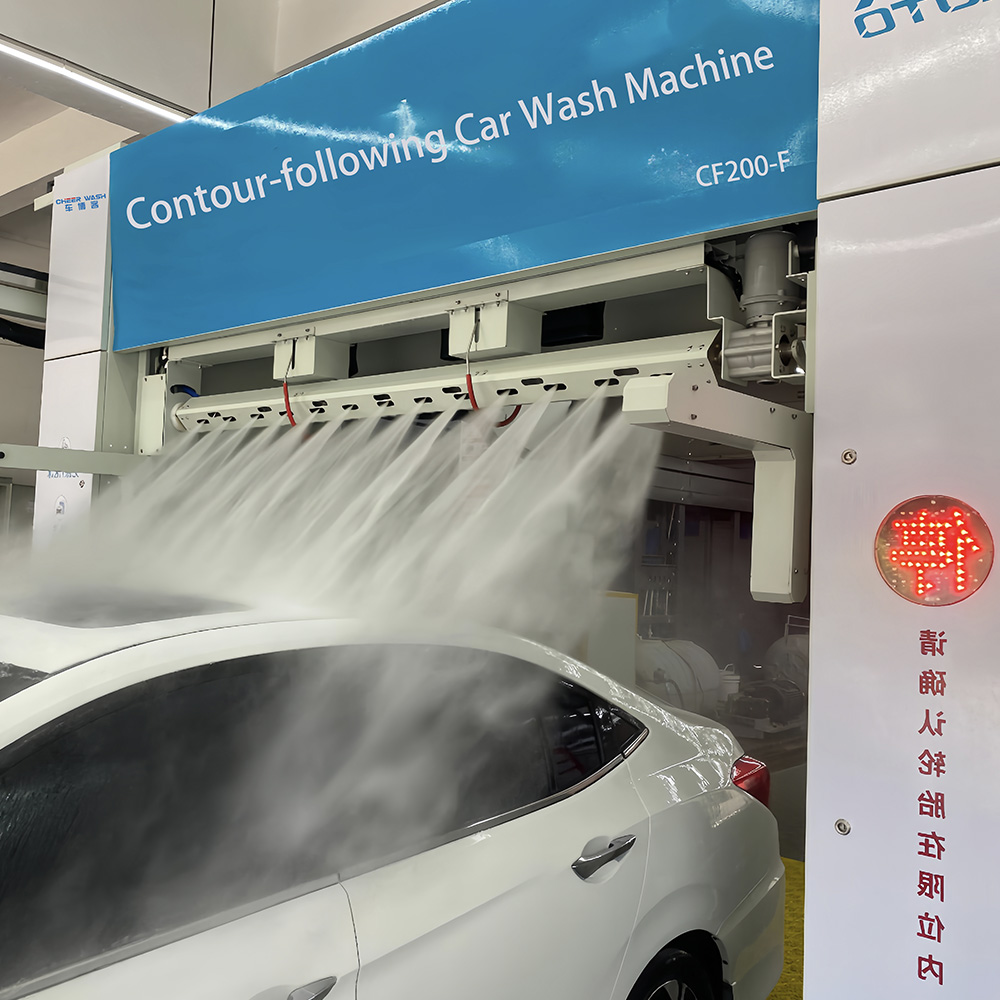
Achieving optimal impingement and friction in automated vehicle cleaning requires maintaining a precise, consistent distance between the wash apparatus and the vehicle surface, regardless of the vehicle's shape. Fixed-axis or purely mechanical wash arms fail to adapt to diverse modern vehicle profiles, such as aerodynamic curves, roof racks, and open pickup beds. This failure results in uneven cleaning performance, excessive chemical and water waste, and a high risk of catastrophic vehicle damage or equipment collision. To mitigate liability and maximize wash quality, operators must evaluate how a contour following wash system utilizes advanced sensor arrays and closed-loop control logic to dynamically dictate the vertical movement of the top wash arm.
Precision Requires Redundancy: Reliable vertical movement relies on a combination of ultrasonic, photoelectric, magnetic, and mechanical feedback sensors to map vehicle topography in high-moisture environments.
Real-Time Actuation: A true profiling car wash machine processes sensor data through a Programmable Logic Controller (PLC) to adjust Variable Frequency Drives (VFDs), enabling smooth, continuous vertical tracking rather than stepped, jerky movements.
Risk Mitigation & Adaptive Motion: Advanced systems incorporate motor current monitoring and rotational sensing as fail-safes. If the wash arm encounters an unmapped obstacle, the system can either trigger an immediate vertical retraction or transition into an oscillating motion to clean around the obstruction safely.
Evaluation Criteria: When selecting a sensor guided contour wash, buyers must prioritize sensor environmental resilience (IP69K ratings), calibration frequency, and the system's ability to maintain throughput speeds without sacrificing contouring accuracy.
The Engineering Baseline: Why Vertical Movement Matters
Defining the Success Criteria
Wash quality depends entirely on applied physics. Water pressure impact, commonly known as impingement, degrades exponentially as the distance between the nozzle and the target increases. Chemical application suffers the exact same fate. Vertical contouring maintains the optimal sweet spot for cleaning efficiency. This critical distance typically ranges from 12 to 18 inches from the vehicle surface. Staying within this specific range guarantees uniform chemical coverage and maximum mechanical cleaning power to break static road film.
When the wash manifold drifts outside this operational window, the kinetic energy of the water droplets dissipates into the surrounding air. Wind drift catches the spray pattern, atomizing the water before it ever strikes the clear coat. We see this exact phenomenon in older bays where the top arm sits statically at 36 inches above a low-profile sports car. The water simply mists over the hood, leaving a distinct layer of dirt untouched.
Distance from Nozzle to Vehicle
Impingement Force Retention
Chemical Coverage Efficiency
12 to 18 Inches
100% (Optimal)
Maximum foaming, excellent dwell time, zero wind drift.
High wind drift, poor adhesion, rapid chemical runoff.
48+ Inches
<20% (Failing)
Severe chemical waste, zero mechanical impact, misting effect.
The Shift to Profiling
Legacy sonar-only systems relied heavily on reactive obstacle avoidance. They moved the wash arm only when they detected an immediate physical threat. The modern Contour-Following Car Wash Machine represents a massive evolutionary leap in equipment design. It shifts daily operations from reactive dodging to proactive vehicle mapping and dynamic payload sensing. This allows the equipment to anticipate curves rather than merely reacting to them.
In the field, reactive systems constantly overshoot their targets. A reactive arm detects a steep windshield, panics, and jerks upward, often lifting far higher than necessary and missing the roof entirely. Proactive mapping eliminates this erratic behavior. By scanning the vehicle before the wash cycle begins, the system knows exactly when the windshield ends and the roof begins, allowing for a smooth, calculated transition.
Anatomy of the Top Arm
Sensors do not move the wash arm directly; they control specific mechanical components. The vertical movement relies on a heavy-duty gantry hoist system. This mechanical setup translates digital sensor signals into physical vertical adjustments, lifting and lowering the manifold to match the vehicle profile. The sequence of operation follows a strict mechanical path:
Sensor Array Data Acquisition: Optical and acoustic sensors gather raw distance metrics.
PLC Trajectory Calculation: The controller processes the data and plots a physical path.
VFD Frequency Modulation: The drive alters the electrical frequency sent to the motors.
Hoist Motor Actuation: The motors engage, turning the primary drive shaft.
Belt or Cable Adjustment: Heavy-duty lifting straps raise or lower the physical manifold.
Feedback Loop Verification: Secondary sensors confirm the arm reached the target height.
Core Sensor Technologies Driving Vertical Wash Arm Movement
Ultrasonic Sensors (Depth and Distance)
These sensors emit high-frequency sound waves, typically around 40 kHz, that bounce off the target. They measure the exact distance to the vehicle's hood, windshield, and roof by calculating the time it takes for the echo to return. They are highly effective for continuous distance tracking during the wash cycle. The internal piezoelectric crystal pulses rapidly, providing real-time depth perception to the controller.
However, implementation realities in a wash bay present unique challenges. High-pressure water spray, dense chemical fog, and extreme temperature fluctuations disrupt acoustic signals. A blast of cold water in a heated bay creates a thermal gradient that actually changes the speed of sound, skewing the sensor's distance calculation. To combat this, industrial-grade ultrasonic sensors feature built-in temperature compensation algorithms and software filtering to ignore false echoes generated by heavy water droplets.
Photoelectric and Infrared Light Curtains (Silhouette Mapping)
Light curtains create an invisible grid of intersecting infrared beams at the wash bay entrance. As the vehicle drives forward and breaks these beams, the system builds a digital profile. It creates a highly accurate 2D or 3D map before the wash arm even begins moving. The resolution of this map depends entirely on the beam spacing; tighter spacing yields a more detailed silhouette.
This provides the foundational map for a contour following car wash machine. It allows the PLC to pre-calculate the required vertical trajectory accurately, anticipating sudden drops like a pickup truck bed. The controller uses a shift register array to track the vehicle's exact position as the gantry moves down the track, matching the pre-scanned silhouette to the physical location of the wash arm.
Magnetic Reed Switches and Hall Effect Sensors (Rotational Verification)
These components utilize magnets mounted directly to the rotating spray arms or brush hubs. They sense continuous movement by counting magnetic peaks as the arm spins past a semiconductor. While distance sensors guide the vertical drop, magnetic sensors verify the wash components are actually spinning. They act as the primary mechanical watchdog for the entire top arm assembly.
If rotation stops suddenly, it indicates potential entanglement or proximity binding. A mirror might have caught the arm, or a loose piece of trim could be jamming the bearing. The controller instantly commands an emergency vertical lift to prevent damage. This rotational verification happens in milliseconds, often lifting the arm before the customer even realizes a jam occurred.
Motor Current, Force, and Pressure Sensors (Tactile Fail-Safes)
This sensor array monitors the electrical current drawn by the primary lift motors. It also measures the payload weight of the arm and internal water pressure levels. Sudden physical resistance spikes the motor current if the arm makes unintended contact with a vehicle. The VFD monitors this amperage draw constantly. If the baseline running current is 3 amps, and it suddenly spikes to 8 amps, the drive knows the arm hit something solid.
Force sensors detect abnormal payload weight, such as heavy ice buildup or mechanical binding in the hoist. If the lifting straps freeze, the force required to move the arm increases dramatically. This data triggers the controller to reverse vertical movement immediately, clear the obstacle, and log a fault code for the maintenance team.
The Control Loop: Translating Sensor Data to Vertical Actuation
Signal Processing and PLC Integration
The programmable logic controller acts as the central brain of the entire operation. It merges pre-mapped light curtain data with real-time ultrasonic and pressure sensor feedback in milliseconds. This continuous data stream allows the PLC to calculate precise vertical positioning on the fly. The controller typically operates on a scan rate of 10 to 20 milliseconds, meaning it re-evaluates the arm's position dozens of times per second.
It utilizes Proportional-Integral-Derivative (PID) control loops to ensure the arm reaches the target distance without overshooting or oscillating wildly. The proportional band handles the gross movement, the integral corrects long-term drift, and the derivative dampens the motion as the arm approaches the target. This mathematical harmony prevents the wash arm from bouncing up and down as it tries to find the perfect 12-inch distance.
Variable Frequency Drives (VFDs) in Hoist Mechanisms
VFDs control the electrical frequency supplied to the lift motors to ensure vertical movement remains fluid. Acceleration and deceleration ramps programmed into the VFDs dictate how quickly the motor reaches full speed and how gently it comes to a stop. They prevent mechanical wear on the belts and pulleys. More importantly, they eliminate stepped, jerky arm movements that could easily damage equipment or strike the vehicle surface.
Advanced systems utilize sensorless vector control rather than basic scalar (V/Hz) control. Vector control provides full motor torque at zero speed. This means the VFD can hold the heavy wash manifold perfectly still in mid-air without relying on a mechanical brake, allowing for instantaneous, smooth vertical adjustments the moment the PLC commands a move.
VFD Parameter
Function in Hoist Control
Typical Field Setting
Acceleration Ramp
Controls how fast the arm starts moving upward.
1.5 to 2.5 seconds (prevents belt snapping).
Deceleration Ramp
Controls how gently the arm stops moving.
1.0 to 2.0 seconds (prevents manifold bouncing).
Current Limit
Sets the maximum allowable amperage before faulting.
150% of motor Full Load Amps (FLA).
Minimum Frequency
Prevents the motor from stalling at low speeds.
15 Hz (ensures adequate cooling fan rotation).
Dynamic Speed Adjustment
The horizontal travel speed of the gantry must synchronize perfectly with the vertical movement speed of the wash arm. This synchronization maintains a consistent contour over steep vehicle angles. Transitioning from a slanted windshield to a flat roof requires precise speed coordination. The PLC constantly calculates the vector math required to keep the nozzle at a perfect 90-degree angle to the surface.
If the gantry moves horizontally faster than the arm can lift vertically, a collision is imminent. The controller must dynamically slow down the gantry's drive wheels when the top arm encounters a steep incline, giving the hoist motors enough time to clear the obstacle. Once the arm reaches the flat roof, the gantry can safely accelerate back to its normal wash speed.
Adaptive Oscillation for Obstacle Management
Modern PLCs handle physical anomalies with sophisticated logic. They do not merely abort the wash cycle upon detecting a complex obstacle like a police light bar or a taxi sign. Aborting the wash leaves the customer stranded with a soapy car. Instead, the system transitions the spray arm from continuous contouring into a targeted oscillating motion.
When the ultrasonic sensors detect an unmapped protrusion, the PLC locks the vertical height just above the obstacle. It then commands the arm to oscillate rapidly back and forth while the gantry creeps forward. This adaptive movement maintains high wash pressure, navigates safely around the obstruction without making physical contact, and ensures the vehicle leaves the bay completely clean.
Evaluating Sensor-Guided Contour Wash Systems (Decision Framework)
Features-to-Outcomes (Wash Quality vs. Throughput)
Operators face a distinct operational trade-off. Highly precise contouring requires slower gantry speeds to track complex curves accurately. You must balance this mechanical precision against the operational need for high vehicles-per-hour throughput. Fast wash cycles often require smoothing out the contouring path, which slightly increases the distance between the nozzle and the vehicle, marginally reducing impingement.
A true profiling car wash machine allows operators to select different wash packages that adjust this logic. A premium wash package might run the gantry at a slower speed, allowing the top arm to track the vehicle profile within a tight 12-inch tolerance. An express wash package might increase gantry speed and loosen the contouring tolerance to 18 inches, sacrificing a small amount of impingement for a faster bay clearance time.
Environmental Resilience and Sensor Degradation
Optical, acoustic, and magnetic sensors face incredibly harsh conditions inside a wash bay. Chemical fog, hard water scaling, and physical debris degrade sensor accuracy over time. A light curtain covered in dried wax cannot accurately map a vehicle. Demand IP69K-rated sensors for maximum protection against high-pressure, high-temperature washdowns. This rating ensures the internal electronics remain completely sealed against water ingress.
Look for self-cleaning sensor housings. Many top-tier manufacturers integrate compressed air blow-offs directly into the sensor mounts. Before every wash cycle, a quick blast of air clears water droplets and chemical residue from the lenses. Redundant sensor arrays are mandatory. If a primary ultrasonic sensor fails, the system must seamlessly fall back on the light curtain data to prevent a single-point failure from shutting down the bay.
Scalability and Fleet Adaptation
Evaluate the software capability of the equipment. It must recognize and adapt to complex profiles like ladder racks, ski boxes, and open pickup truck beds. Auto-sensing logic should adjust to the vehicle's unique payload and shape without manual operator intervention. Systems lacking this adaptability will inevitably cause damage to unconventional vehicles.
When a pickup truck enters the bay, the light curtains map the cab, the sudden drop of the rear window, and the flat expanse of the open bed. The PLC must recognize this specific geometric signature. Instead of dropping the wash arm into the bed—which risks colliding with the tailgate on the way out—the software should lock the arm at the height of the bed rails, angling the high-pressure nozzles downward to flush out the interior safely.
Implementation Risks and Mitigation Strategies
Calibration Drift
Sensors operating in high-vibration environments inevitably lose calibration over thousands of wash cycles. The constant movement of the gantry shakes mounting brackets loose, slightly altering the angle of the ultrasonic cones. You must implement automated diagnostic routines and pressure level testing. Establish rigorous and regular preventative maintenance schedules to keep sensors accurate.
Wipe down all photoelectric lenses with a microfiber cloth and approved glass cleaner weekly.
Verify the physical alignment of the light curtain transmitter and receiver towers monthly.
Test ultrasonic echo returns by placing a known object at exactly 24 inches and verifying the PLC readout.
Inspect the magnetic reed switches for physical damage or loose wiring harnesses.
Check the VFD fault logs for any unexplained motor current spikes indicating hoist binding.
Software Obsolescence
A sensor guided contour wash relies heavily on proprietary algorithms to interpret data. Assess vendor track records carefully before purchasing. Ensure they provide frequent firmware updates capable of recognizing newer, unconventional vehicle designs, such as sharp-angled electric vehicles or modified off-road trucks. Stagnant software leads to increased collision risks as vehicle designs evolve.
Automotive manufacturers constantly push the boundaries of aerodynamics. A sensor algorithm written ten years ago might misinterpret the aggressive rear spoiler of a modern electric SUV as an open pickup bed, causing the arm to drop incorrectly. Partner with manufacturers who actively update their PLC logic based on real-world field data and new vehicle releases.
Retrofitting vs. New Equipment Purchases
Adding sensor-guided vertical control to existing fixed-axis gantries presents severe technical hurdles. Examine the financial viability of retrofitting older frames with modern PLCs and VFDs. Often, the mechanical slop in older hoists negates the precision of new sensors. Worn out gearboxes and stretched lifting belts introduce physical lag that the software cannot correct.
If the PLC commands a one-inch drop, but the stretched belt has two inches of slack, the arm will not move. The sensor reads no movement, commands another drop, the slack suddenly catches, and the arm plummets three inches. Investing in a natively integrated profiling machine generally offers better long-term reliability, tighter mechanical tolerances, and superior wash performance.
Conclusion
Audit your current damage claim rates and chemical usage metrics to identify operational inefficiencies caused by poor contouring.
Request a technical demonstration of a vendor's PLC logic specifically regarding obstacle detection and oscillating motion around complex vehicle profiles.
Calculate the return on investment of upgrading to a fully profiling system based on throughput increases, chemical savings, and damage reduction.
Establish a preventative maintenance schedule focused strictly on sensor calibration, lens cleaning, and VFD parameter checks.
FAQ
Q: How does a contour following car wash machine detect vehicle shape?
A: It uses a combination of photoelectric light curtains at the bay entrance to map the vehicle's silhouette. Ultrasonic sensors on the wash arm measure real-time distance. This combined data feeds into a central controller to build a precise physical profile before the wash begins.
Q: What prevents the vertical wash arm from crashing into the vehicle?
A: Redundant safety systems prevent collisions. If primary distance sensors fail, motor current sensors detect abnormal physical resistance. Force sensors detect payload anomalies. These fail-safes instantly trigger the arm to retract vertically away from the vehicle surface.
Q: How does the system know if the spray arm stops spinning during a contouring wash?
A: Advanced systems use magnetic reed switches or Hall effect sensors mounted to the rotating arm. By counting the magnetic peaks, the controller verifies continuous movement. If rotation stops, the system assumes an obstruction exists and retracts the arm immediately.
Q: Can a sensor guided contour wash handle pickup trucks with open beds?
A: Yes. Advanced profiling systems are programmed to detect the sudden drop in elevation characteristic of an open pickup bed. The sensors map the depth and adjust the vertical arm to clean the interior without colliding with the tailgate or cab.
Q: Why is variable frequency drive (VFD) integration necessary for vertical movement?
A: VFDs control the acceleration and deceleration of the lift motors. This ensures the vertical movement is smooth and continuous. Without VFDs, the arm would move in a stepped, jerky manner, increasing mechanical wear and the risk of vehicle impact.
Q: How does chemical fog affect ultrasonic sensors in a wash bay?
A: Dense chemical fog and high-pressure spray can scatter the sound waves emitted by ultrasonic sensors, causing false distance readings. To combat this, modern systems use redundant sensor arrays, including optical light curtains and tactile fail-safes, to maintain accurate positioning.